
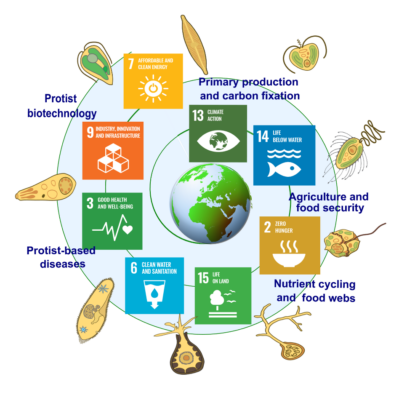
Anthrpogenic activity, since the Industrial Revolution, has had disastrous consequences, contributing to global warming, biodiversity loss, placing the stability and resilience of the Earth Ecosystem in grave danger (Lee et al., 2023; Richardson et al., 2023). Academic researchers have a critical role in our understanding of global ecosystems, and in evaluating the speed and gravity of the current ecological crisis. This is particularly true for phycology, a discipline that studies algae that have fundamental roles in structuring aquatic ecosystems, and whose fragility to climate breakdown remains poorly understood (Perrin et Dorrell, 2024). However, scientific research has its own major impacts on the environment (De Paepe et al., 2024; Valls-Val et Bovea, 2021), necessitating a deeper reflection and an active engagement to mitigate these impacts.
Multiple universities and research insitutes in France and abroad, have put in place frameworks and action plans for the green transition. The obligation for the phycological research community, both at national and international levels, is to find tractable strategies to limit the environmental footprints of its research, and this responsibility is shared by learned research societies.
Mission statement
The French Phycological Society (SPF), on behalf of its members, engages to take environmental impacts as a core value in its day-to-day functioning, to minimise its environmental footprint and to accompany the progressive transition to sustainable research practices in the phycology community. The society recognises that these objectives have to be balanced against the needs of specific research projectts, and the national and international mobility of its members. Finally, the SPF recognises that it itself plays a role in the communication and the explanation of the ecological crisis to the broader public.
The General Assembly of the SPF thus engages to support the following measures :
- For its annual conferences (« the SPF Workshops ») : the SPF suggests to travel by train where possible, avoiding flights. In general, we recommend to avoid using flights to travel between destinations in France, or in Europe, when an equivalent train journey of less than 6 hours is possible.
- Encourage, where the logistic and personal circumstances of its laureats permit, that the international mobility prizes given to junior members of the society are used to allow ecologically responsable travel to international conferences. We notify all candidates for this prize, when they enrol to the SPF workshop, that we will invite them, if awarded a prize, to justify the specific use of the funding awarded. These details will be published on the SPF’s website.
- For meal services and coffee/ tea breaks during the SPF workshops, we engage to favour catering that is environmentally-friendly, e.g. the use of organic or locally-produced products, vegetarian/ vegan menus, or homemade rather than mass-produced, and to minimise waste generated through this via reduction, reuse, redistribution, recycling, and composting.
- For its finances, use banks and savings programs with clearly described ethical investment policies, which are accredited from an external source (e.g., RSE Certification).
- Actively promote the role of citizen science for understanding the impacts of environmental change on algae and on coastal ecosystems, for example via the International Day for Biological Diversity or the French “Fête de la Science”, and promote open training sessions for researchers who wish to engage with environmental and climate crisis questions, for example the workshop « Fresque du climat ».
The GA of the SPF thanks Zhou Xu (Sorbonne Université) and Abi Perrin (York University) for their help with the preparation of this environmental statement.
Références citées
De Paepe, M., Jeanneau, L., Mariette, J., Aumont, O., and Estevez-Torres, A. (2024). Purchases dominate the carbon footprint of research laboratories. PLOS Sustainability and Transformation 3, e0000116.
Lee, H., Calvin, K., Dasgupta, D., Krinner, G., Mukherji, A., Thorne, P., Trisos, C., Romero, J., Aldunce, P., and Barrett, K. (2023). Climate change 2023: synthesis report. Contribution of working groups I, II and III to the sixth assessment report of the intergovernmental panel on climate change (The Australian National University).
Perrin, A.J., and Dorrell, R.G. (2024). Protists and protistology in the Anthropocene: challenges for a climate and ecological crisis. BMC Biology 22, 279.
Richardson, K., Steffen, W., Lucht, W., Bendtsen, J., Cornell, S.E., Donges, J.F., Drüke, M., Fetzer, I., Bala, G., and Von Bloh, W. (2023). Earth beyond six of nine planetary boundaries. Science advances 9, eadh2458.
Valls-Val, K., and Bovea, M.D. (2021). Carbon footprint in Higher Education Institutions: a literature review and prospects for future research. Clean Technologies and Environmental Policy 23, 2523-2542.